Companion planting has a mixed reputation, partly because the claims made for it vary wildly in quality. Some combinations have real evidence behind them. Others are gardening folklore that got repeated enough to acquire the patina of fact. Sorting out which is which saves you from designing your entire garden around relationships that don't deliver what the books promise.
The honest version is that companion planting works, but more selectively and less dramatically than the most enthusiastic champions argue. The right pairings reduce pest pressure, attract beneficial insects, and make more efficient use of bed space. The wrong pairings just crowd plants that would have performed better with more room.
Combinations With Real Evidence Behind Them
Basil and tomatoes are the canonical example, and the mechanism holds up. Basil repels thrips and aphids, and its aromatic compounds may reduce some fungal pressure on nearby plants. Planted at the tomato's base, it also makes efficient use of the vertical space the tomato dominates overhead. Whether basil actively improves tomato flavor, as some claim, is a weaker research question, though I'd hold that loosely since the proposed mechanism (volatile compound transfer through the soil) isn't implausible.
Legumes and almost everything else are a more reliable pairing because the mechanism is clear. Beans and peas fix atmospheric nitrogen through their root nodules. Planted alongside heavy feeders like corn or squash, they contribute nitrogen to the shared soil while the heavy feeder exploits it. The Three Sisters planting system, corn, beans, and squash grown together, is one of the most extensively documented examples of companion planting that actually performs as advertised.
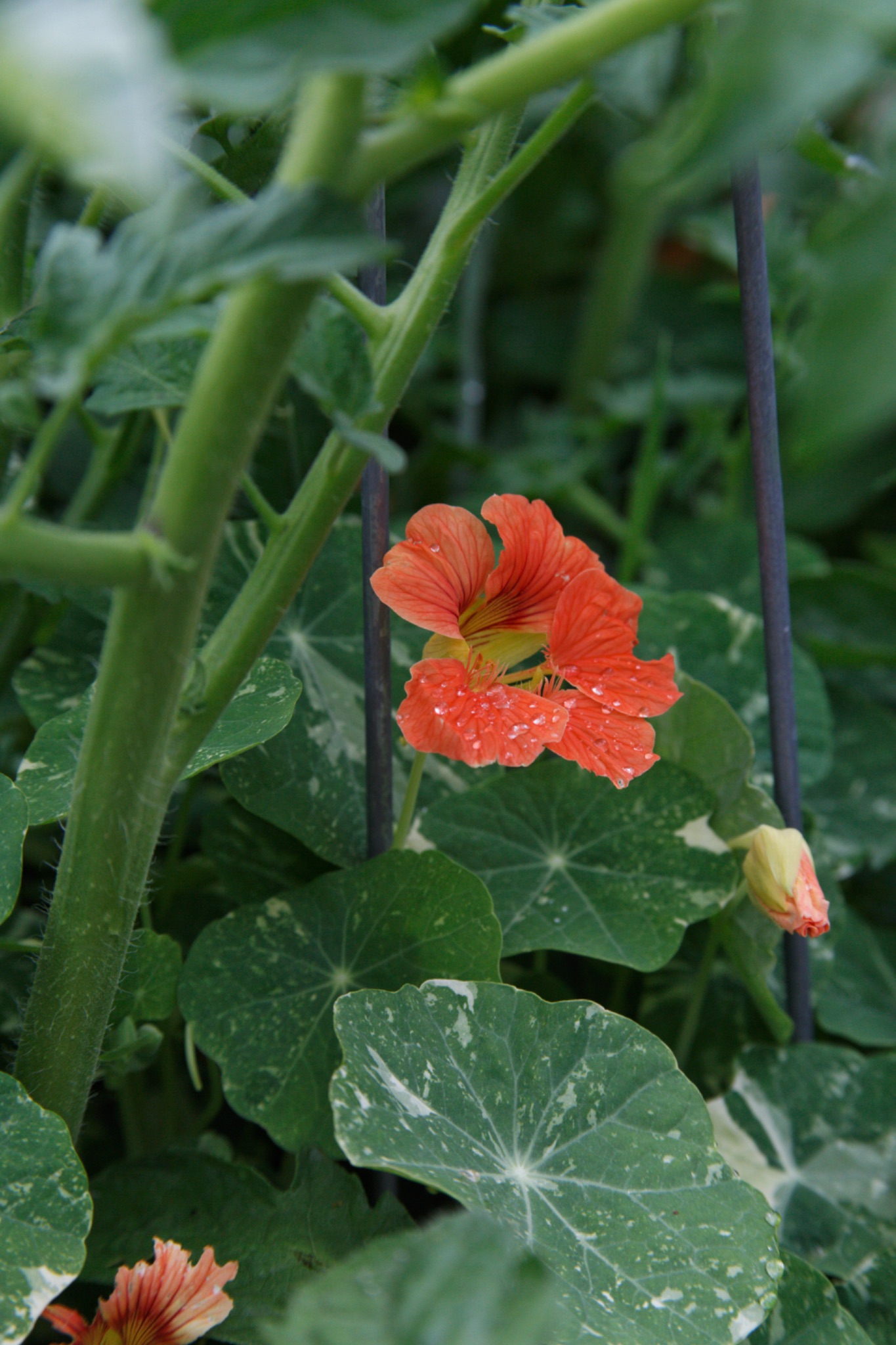
Nasturtiums planted near brassicas attract aphids away from the crop and toward themselves, functioning as a trap crop. You sacrifice the nasturtium to save the kale. This works reliably enough that commercial growers deliberately use the strategy.
Marigolds, particularly French marigolds, produce root exudates containing a compound called alpha-terthienyl that suppresses plant-parasitic nematodes in the soil. [1,2] The effect is localized and takes a full growing season to develop, which means planting marigolds the same week you're experiencing nematode problems doesn't solve anything... it addresses next season's problem, not this one. Plant them as a preventive measure, consistently, over multiple seasons.
What Probably Doesn't Work As Claimed
Planting carrots and onions together to repel each other's pests shows up in almost every companion planting guide. The carrot fly and the onion fly are supposed to confuse each other when the crops intermingle. The evidence for this is predominantly anecdotal. Worth taking with a healthy measure of skepticism before you design a bed around it.
Chamomile as a universal growth accelerator for neighboring plants is another claim that circulates widely, with little support. Chamomile is a reasonable companion for certain crops and a poor one for others, depending on growth habit and root competition, but the broad claim that it makes everything nearby grow faster is not credible.
Companion Planting and Soil Biology
Not entirely relevant, but worth pausing on: the underlying mechanism in several effective companion plantings is soil biology rather than anything happening above ground. Different plants deposit different compounds through their roots, feed different segments of the microbial community, and create different environments in the soil they share. Diverse plantings tend to support diverse soil biology in ways monoculture beds don't.
Biologically active soil amendments, including liquid fertilizers derived from organic processing by-products through a natural digestion process, fit naturally into companion-planted beds for this reason. They introduce microbial diversity that benefits the whole community of plants rather than a single crop.
Varieties That Reward Companion Planting
Open-pollinated and heirloom varieties tend to be better suited to companion planting contexts than hybrids bred for uniform monoculture conditions, simply because they weren't selected for optimized performance in sterile, isolated beds. A Dragon Tongue bean planted with a summer squash and a nasturtium at the border is performing in roughly the ecological context it was developed within.
Heirloom and open-pollinated varieties selected for exactly this kind of growing reward companion planting especially well. Flowers like borage, anise hyssop, and calendula aren't ornamental afterthoughts in a productive garden. They're companion crops that pull their weight in mixed plantings.
The best companion planting combinations aren't magic. They're just ecology applied at the garden scale. Work with the relationships that have actual evidence behind them, and let the folklore sort itself out over a few seasons of observation.
About the Author
Brigham and Alicia Stoehr are co-founders of Good Land Seed Company, an heirloom and open-pollinated seed company in Southwest Idaho. Brigham writes and grows from the ecology side, focused on soil health, native plants, and seed saving. Alicia is an oncology RN who has spent years growing food and flowers for everyone she knows, bringing the same precise care to the garden that she brings to her patients. Every variety in their catalog is variety-stable, meaning the seed you buy can be saved, replanted, and passed on indefinitely. Explore their seed catalog and free resources on seed saving and soil biology at goodlandseed.com.
Citations
1 Hooks, C.R.R., Wang, K.-H., Ploeg, A., and McSorley, R. "Using Marigold (Tagetes spp.) as a Cover Crop to Protect Crops from Plant-Parasitic Nematodes." Applied Soil Ecology 46 (2010): 307–320. https://doi.org/10.1016/j.apsoil.2010.09.005
2 Crow, W.T. "Marigolds (Tagetes spp.) for Nematode Management." University of Florida IFAS Extension, EDIS Publication NG045, 2019. https://edis.ifas.ufl.edu/publication/NG045